

In the fall of 2001 I enter a Kempo Karate school in Munich for the first time and right at the beginning I learn how to greet the teacher, the Sensei. The warm-up training begins, the air is stuffy after a short time and the windows are opened. It is very loud, clear announcements are made, but still there is an atmosphere of togetherness. During intensive partner exercises and stressful technique training, people still look out for each other. In between, they often bow to each other and at the end of the training they say goodbye to the teacher and everyone else.
I had just finished the Bundeswehr and I still remembered situations where people didn’t pay much attention to each other, where they interrupted each other, talked over each other, didn’t listen or even behaved in an insulting, hurtful or condescending way — where you didn’t seem to care about the other person. Perhaps you know this from your own experience: It can feel extremely uncomfortable.
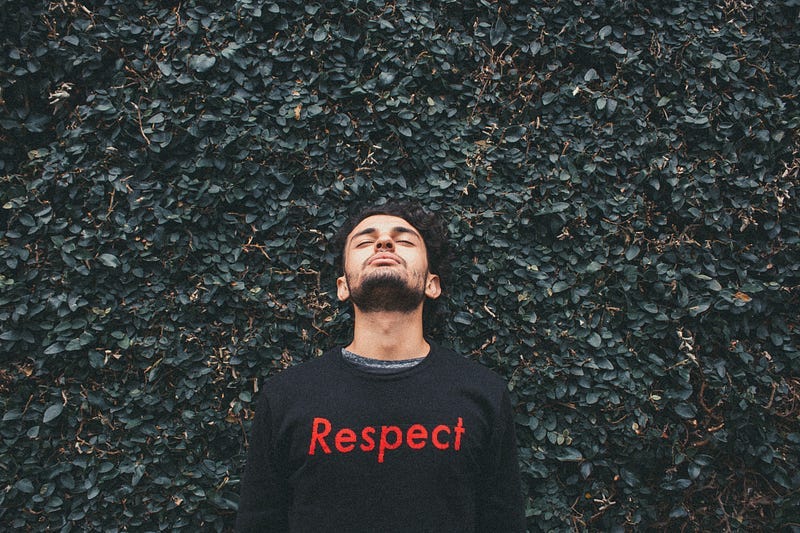
Many years later, in 2020, I am new to the job as Scrum Master. I was pleased to see the value of “respect” emphasized. Scrum team members respect each other as capable, independent people. They are also respected as such by the people they work with.1 So according to the inventors of Scrum, respect seems to have a special meaning for collaboration.
In my 20 years of karate training and later as a Scrum Master, I have always asked myself, what is respect? How do I behave respectfully? And why exactly is that worth striving for in the first place?
What Respect Is
Respect is a very multi-faceted value that carries respect, recognition, tolerance, politeness and appreciation. But respect also has to do with authority, prestige and fear.
“Respect always gains importance in context.” said my Karate teacher a few years after I started training. “You can have respect for age. You can have respect for a person’s knowledge, and you can have respect for a snarling dog.”
Respect for age is expressed when, for example, you help an elderly, insecure lady cross a busy street. Respect for knowledge and wisdom is shown when one listens to the elaborate arguments of a professor and thinks them through for oneself. But you can also show respect when you look at a dog.

Power means every chance to assert one’s own will within a social relationship even against opposition […]. (Max Weber)
The sergeant major bares his teeth and barks orders at the recruit. Inevitably, adrenaline is released, stress is created, the senses are put on alert. When the recruit tells his friends about this situation, he will probably prefer to mask the emotion “fear” with the term “respect,” because “I had respect for the sergeant” just sounds better than “I was afraid.”
“Respect means seeing the other person”
Whereas in earlier times there was a strong focus on threatening punishment and giving punishment for errant behavior to induce fear of consequences, today it is more about negotiation and discussion. A common understanding is in many cases much more profitable than mindless execution of orders. Fortunately, in many areas of our society, one can observe a strong shift from a command culture to a negotiation culture.
In my eyes, this negotiation and discussion is not only more profitable, but at the same time much more difficult than issuing a command, because it requires patience, perseverance and a sincere interest. It is the necessary prerequisite for fathoming the motives and needs of the other person, because — as René Borbonus so beautifully puts it — “respect means seeing the other person”.2
1. Distinction: The Two Dimensions of Respect
Professor van Quaquebeke from Hamburg, who has conducted intensive research on the topic of “respect” and is a mentor of the RespectResearchGroup, distinguishes between horizontal respect and vertical respect.3
Horizontal respect shows itself in a general respect, empathy and appreciation for my counterpart. So when we help an elderly lady cross the street, it happens on exactly this basis: appreciation. This horizontal respect is not tied to any conditions, which is why we can demand it from those around us.
Vertical respect, on the other hand, has to be earned. It is linked to performance. If the performance declines, so does the respect. The respect for the professor, goes back to his achievement, that he has spent many years in a subject. Vertical respect is therefore linked to conditions.
With this central distinction of the two components, let us now look at three levels that are also related to respect.
2. Distinction: Being Respectful on Three Levels
Helping someone to get across the street, for example, or listening to someone to understand (rather than respond) are two ways of expressing respect. In my mind, however, there are three levels at which to establish respectful behavior:
In actions — this is the most obvious level: in martial arts, this is shown in bowing to each other (which is roughly equivalent to shaking hands in everyday life). An obvious gesture that shows that you see the other person.
In words: showing respect at this level means refraining from insulting, hurtful and condescending remarks and discussing the matter with arguments. This requires listening to the other person and, if necessary, perceiving his or her motives.
In attitude: At this level, respect manifests itself as a basic openness to the other person’s perspective and the desire to let the other person keep his or her dignity.
The most practical level, which we encounter most often in everyday life, is certainly the verbal level.
Respect on the Verbal Level
Respect is like air. If there is air to breathe, then no one thinks about it. But as soon as it’s missing, you don’t think about anything else.
Kerry Patterson and the authors of Cruicial Conversations4 use the metaphor of air to make clear how necessary respect is in conversations. They believe that as soon as people feel disrespected, it is no longer about the content of the conversation, but only about defending dignity. A lack of respect can therefore be recognized by the fact that participants in a conversation want to assert their dignity.
When people feel disrespected, they become tense. Their fear turns into anger, then they sulk, shout or threaten.
If it has already come to that, then feelings are key. Acknowledging the other person’s feelings, addressing them, and mirroring them can help ease the situation. After all, naming feelings helps to cope with them.5

To come back to Professor van Quaquebeke: Respect also means that I have to deal with what is being said and that I am allowed to be irritated by it. Even if we haven’t found a solution, remaining respectful and enduring the frustration. We must remain in dialogue until we have found a solution.
For me, that means making sure that people feel less disregarded: Allowing the other person to speak and finish, repeating in my own words what has been said to check my understanding, ensuring balanced proportions of speech and, if possible, creating a safe framework so that critical issues can also be addressed.
Respectful Behavior Promotes Good Cooperation at Work
I think respectful behavior is so important because it improves team interaction and collaboration. When interactions are fact-oriented, we solve problems faster and more efficiently than when we don’t see eye to eye on the relationship level. Personal attacks make work difficult and slow.
I don’t know about you, but for me, I prefer to work with people who I know respect me. Being able to interact on a trusting level has a much higher fun factor for me.
Instead of being tense because you have to think about every statement three times, the conversations run with a certain looseness. Tricky problems can be talked through and thought through together, and even unusual trains of thought can be expressed without the verbal evaluation club rattling down on you.

It’s also much easier to learn in an open, basically relaxed atmosphere. In the field of knowledge work, it is essential that we learn new things about our customers, about our product and about our technical tools. In my opinion, a basic respect promotes this atmosphere.
Conclusion
Respect is the oxygen among the social elements: indispensable for social survival, but not self-evident in the atmosphere.
— René Borbonus6
Respect means seeing the other person with his or her needs and motives. As horizontal respect it is unconditional, as vertical respect it is conditional and linked to performance.
To show respect to someone, it can help, on the one hand, to mirror feelings. On the other hand, we should also deal more intensively with what the other person says and let ourselves be irritated by it.
When we experience a person struggling for respect, we should simply give them what they need: a little breathing room.
How’s that for you? Do you ever wish you had more respect on your team or in your environment? What have you tried so far to facilitate more respectful interactions? In general, what are your thoughts on respect? I would love to hear from you in a comment.
Schwaber, K., & Sutherland, J. (2020). The Scrum Guide. The Definitive Guide to Scrum: The Rules of the Game. https://scrumguides.org/scrum-guide.html
Borbonus, R. (10.03.2013). Streit vermeiden: Umgehe diese Rhetorik-Fehler // René Borbonus. https://youtu.be/9869CcKULwo
Köster, B. (02.04.2009). Respekt kann man nicht verlangen. Deutschlandfunk. https://www.deutschlandfunk.de/respekt-kann-man-nicht-verlangen-100.html
Patterson, K., Switzler, A., Grenny, J., & McMillan, R. (Hrsg.). (2012). Heikle Gespräche: Worauf es ankommt, wenn viel auf dem Spiel steht (2., aktualisierte und erw. Aufl). Linde-Verl.
Lieberman, M. D., Eisenberger, N. I., Crockett, M. J., Tom, S. M., Pfeifer, J. H., & Way, B. M. (2007). Putting Feelings Into Words. Psychological Science, 18(5), 421–428. https://doi.org/10.1111/j.1467-9280.2007.01916.x
Borbonus, R. (o. J.). Respekt! Ansehen gewinnen bei Freund und Feind. https://www.rene-borbonus.de/vortraege/respekt.html